
The Deepfake CEO: A Board Risk Hiding in Plain Sight
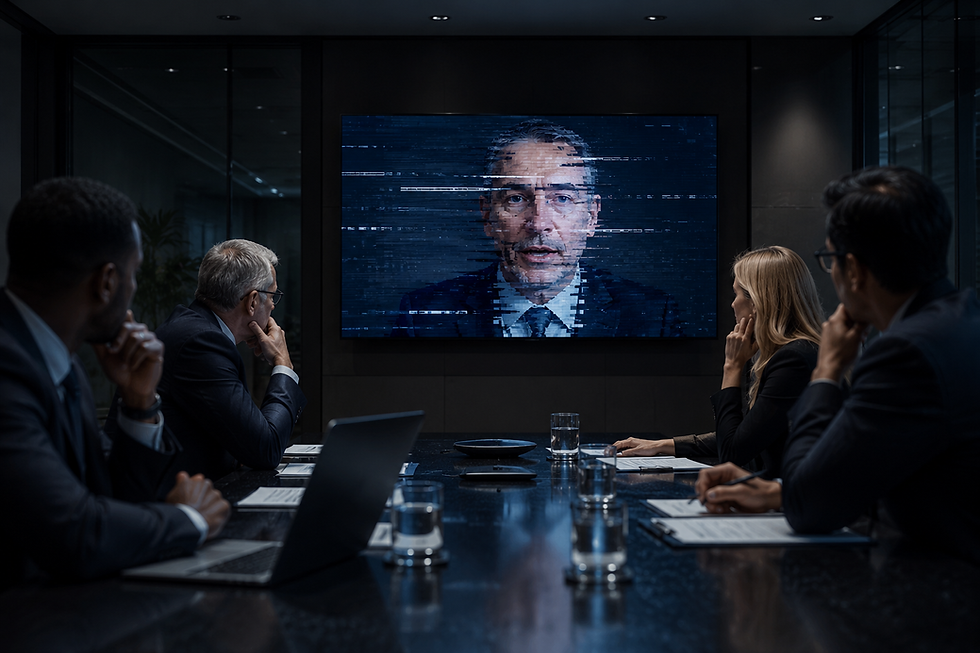
In early 2024, a finance employee at a global engineering firm's Hong Kong office joined a video call with people who looked and sounded exactly like the company's chief financial officer and several other senior colleagues. Every face on that call was fake. The employee authorized fifteen wire transfers totaling more than twenty five million dollars before anyone realized the entire meeting had been generated. That single incident is now the reference case for what boards are calling deepfake CEO fraud, and most governance structures still have no real answer for it.
This is not a rare, isolated event anymore. Gartner's own 2025 survey of cybersecurity leaders found that 62 percent of organizations had already experienced a deepfake attack in the prior 12 months. The question for boards is no longer whether a convincing fake will target their executives. It is whether the company's approval chain can survive one when it arrives.
Why It Matters
Gartner predicts that by 2026, 30 percent of enterprises will no longer consider face biometric identity verification reliable in isolation because of AI generated deepfakes. That prediction was made in 2024, and the timeline has already arrived. The shift is visible at the top of the house too. The World Economic Forum's Global Cybersecurity Outlook 2026 found that chief executives now rate cyber enabled fraud as their top cybersecurity concern, overtaking ransomware, while chief information security officers remain focused on ransomware and supply chain resilience, a divergence the report describes as boardroom priorities pulling apart from front line priorities.
Microsoft's Digital Defense Report has tracked business email compromise evolving into a more commercialized, identity driven form of attack, and a convincing face or voice is simply the next stage of the same pattern, exploiting the trust placed in a familiar identity rather than breaking into a system. The technology that makes this possible is no longer expensive or specialized. A short public speech, a quarterly earnings call, or a handful of media interviews is enough raw material to build a convincing synthetic version of an executive's voice and face.
The Core Framework: Why Deepfake Fraud Works
Deepfake CEO fraud succeeds for a specific reason that has nothing to do with a technical vulnerability. It exploits authority, urgency, and the assumption that seeing and hearing someone is proof of who they are. NIST's own guidance on reducing the risks posed by synthetic content lays out the technical building blocks organizations need, provenance tracking, content labeling, and detection tools, precisely because a human being looking at a screen can no longer reliably tell the difference on their own.
That is the uncomfortable part for boards to absorb. Detection tools have a role, but they are a probabilistic layer, not a guarantee, and the generation technology improves faster than any single detection product can keep pace with. The control that actually holds is procedural, not technical, a second channel verification requirement for any high value financial instruction, regardless of how convincing the request looks or sounds. This is where disciplined IT consulting, dependable managed IT services, and strong integrated risk management earn their keep, not by promising to detect every fake, but by making sure no single video call or phone call is ever the sole authorization for moving money.
Executive teams also need to treat their own public exposure as part of the threat model. Every earnings call, every conference keynote, every media appearance is training data for an attacker building a synthetic version of that executive's voice and likeness. Strong cybersecurity strategy now has to account for that exposure explicitly, and digital engineering strategy discussions inside the company should include how internal systems verify identity when the traditional signals, a familiar face and voice, can no longer be trusted at face value.
Governance Section: What the Board Needs to Ask
Cybersecurity has become a board level governance responsibility because operational resilience directly affects enterprise value, and deepfake fraud is now squarely inside that responsibility rather than a novelty IT teams monitor on the side.
What is the board's role? The board's role is to confirm a documented, tested verification protocol exists for any instruction involving funds movement, data release, or emergency authority, and that the protocol survives a realistic test rather than existing only on paper. MIT Sloan research published through Harvard Business Review found that board level conversations about AI often ignore security entirely, even as boards place greater emphasis on cyber risk overall, which is exactly the gap deepfake fraud exploits.
What risks exist? The primary risk is a finance, HR, or executive assistant employee treating a convincing video or voice call as sufficient authorization on its own, without an independent verification step, especially under the urgency and confidentiality framing that these attacks are built around.
What metrics matter? IBM's Cost of a Data Breach research found that incidents involving compromised identity and social engineering remain among the costliest and slowest categories to contain, which argues for tracking verification protocol compliance the same way the company tracks patch levels or endpoint coverage, not as a one time training completion metric.
What oversight is required? Gartner has already recommended that organizations establish dedicated trust functions to counter deepfake threats rather than treating them as a side responsibility inside IT, and boards should expect a standing report on deepfake readiness the same way they expect a standing report on ransomware readiness, reviewed on a fixed cadence rather than after an incident forces the conversation.
Executive Actions
Boards and executive teams can turn this from an abstract worry into a tested discipline with a short set of concrete steps.
Require independent, second channel verification for any instruction to move funds, release sensitive data, or grant emergency access, with no exception for how convincing the request appeared.
Run a realistic simulation of a deepfake enabled request against the finance and executive assistant teams who would actually receive one, rather than relying on a training module that only tests recognition, not behavior under pressure.
Extend AI risk management and governance to explicitly name synthetic media impersonation as a covered category, with a named owner rather than an assumed one, backed by the governance and process discipline to make that ownership stick.
Route personal exposure assessment and impersonation monitoring to a program built for it. BetterWorld Shield, delivered by BetterWorld Technology, monitors for impersonation and misuse of an executive's identity as part of its ongoing defense work, extending past what a corporate security team can see on its own.
Report deepfake readiness to the board on the same fixed cadence used for other material cyber risks, rather than treating the topic as settled after a single briefing.
Final Thoughts
Deepfake CEO fraud is not a story about technology outpacing defenders, even though that framing is tempting. It is a story about an approval chain that was built for a world where a familiar face and voice were reasonable proof of identity, a world that no longer exists. Boards that treat this as an IT curiosity are making the same mistake they used to make about cybersecurity broadly, waiting for an incident to force a conversation that should have already happened.
The fix is not more sophisticated detection technology, though that has a role. A Principles First Thinking Framework treats deepfake risk the way it treats every other governance question, by asking who owns it, what proof standard actually holds under pressure, and whether the answer has been tested rather than assumed. Executives whose voice and face are now public enough to be convincingly cloned deserve a program built for exactly that exposure, which is what BetterWorld Shield was designed to provide.


Comments